If you are sorting a pile of paperwork before a move or after a water-leak scare, you probably want to know how to store important documents so one fire or one lost folder cannot erase them. The answer starts with sorting each paper by how hard it is to replace, then matching it to a container and location that limits fire, water, humidity, and theft, and keeping a separate digital copy.
What Counts as an Important Document?
An important document is any record that is hard or slow to replace, or that proves your identity, ownership, or tax position. Good storage tips for paper start with sorting: group papers by how hard each one is to replace before you choose a container.
| Document group | Examples | How long |
|---|---|---|
| Identity and vital records | Birth, marriage, and death certificates; Social Security card; passport | Keep originals secure |
| Legal papers | Wills, trusts, powers of attorney | Keep originals secure |
| Tax records | Returns, W-2s, receipts, bank statements | The IRS says 3 years from filing in most cases, 6 years if unreported income is more than 25% of gross income, 7 years for a worthless securities or bad debt claim, and indefinitely if you never filed or filed a fraudulent return |
| Property records | Deeds, vehicle titles, home improvement records | The IRS says until the limitations period ends for the year you dispose of the property |
| Employment tax records (business) | Payroll and tax deposit records | The IRS says at least 4 years after the tax is due or paid, whichever is later |
Sort everything into three piles:
- Keep permanently or while current.
- Keep for a set period, then shred.
- Shred now.
Set a regular review date so records past their period move to the shredder. Retention rules vary by document type, state, and industry, so treat this table as a starting point, not legal or tax advice. The IRS also suggests checking whether insurers or creditors require longer retention. Federal Trade Commission (FTC) guidance for businesses advises shredding, burning, or pulverizing sensitive paper before you discard it.
Fireproof or Waterproof Box vs. Storage Unit: Where Should Important Documents Go?
How to store important documents comes down to choosing between a fire-rated box, a home safe, a bank safe deposit box, and a storage unit, and each trades convenience against a different risk. FEMA suggests considering a fireproof and waterproof box or safe at home, a bank safe deposit box, or a trusted friend or relative for paper copies.
| Location | Often used for | Main limit | What to check |
|---|---|---|---|
| Fire-rated box | Originals you may need quickly | The rating describes a test, and water protection is rated separately | The label, the time rating, and any separate water rating |
| Home safe | Originals kept at home with other valuables | It sits in the same building as the fire or leak you are guarding against | Its rating and where it sits in the house |
| Bank safe deposit box | Irreplaceable originals kept away from home | The FDIC says financial institutions generally do not insure box contents | Who can open the box if you die or are ill (FEMA suggests asking your bank or checking state laws) |
| Storage unit | Bulk, replaceable records such as older tax years | Protection depends on the facility's features and your insurance | Security features, climate control, rental agreement, insurance |
Consider keeping originals of passports, birth certificates, and Social Security cards in a fire-rated box or a bank box, though the choice is yours, and tell one trusted person where the originals are and how to reach them. Document storage in a unit fits bulk, replaceable records, such as older tax years and closed accounts, kept in acid-free file boxes.
What Does a Fire Rating on a Document Box Mean?
A fire rating on a document box describes how the box performed in a standardized heat test, not how it will perform in any real fire. UL 72 is the standard that tests the fire resistance of record protection equipment, and the label from UL Solutions (UL, formerly Underwriters Laboratories) lists a class and a time.
UL says the class is the maximum interior temperature reached during testing, and the time rating is how long the box stays below that maximum. Fire resistance is one claim and water protection is another, so look for a separate water rating on the label or in the manual. Burglary resistance is tested separately by UL, and ratings differ by model.
What to Check Before You Store Paper in a Unit
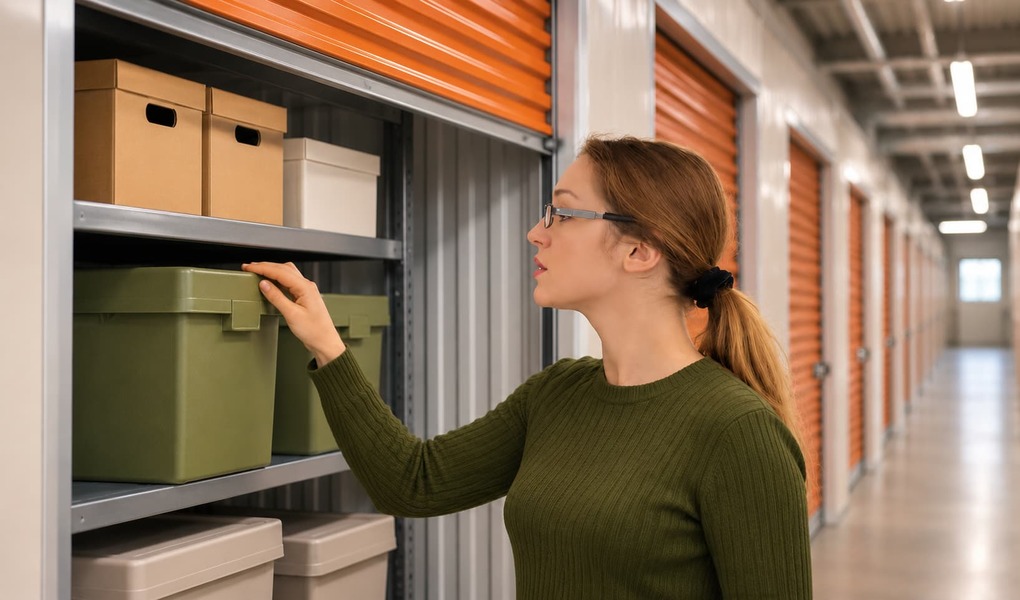
A storage unit can be a reasonable place for bulk, replaceable documents, but how safe it is depends on the specific facility, its security features, and your insurance, all of which vary. USSelfStorage.com is a marketplace that lists facilities and does not operate them, so these storage unit security tips apply to any facility you consider. Before storing documents there, ask about:
- Access control and any gate or camera features.
- Unit-level security options, such as lock choices.
- Whether "climate-controlled" means a stated temperature and humidity range.
- What the rental agreement restricts.
- What happens if a payment is missed.
FTC guidance for businesses advises keeping paper records in a locked file cabinet or room, so a lockable cabinet inside a unit is one option. Most facilities restrict items such as hazardous materials and perishables, but rules vary, so read the rental agreement. Size comes after those checks, and the unit size guide lists a 5x5 as fitting boxes and small furniture. If you do use a unit, organize a storage unit so the document boxes sit toward the front and stay easy to reach.
What to Ask About Storage Unit Insurance
Questions about storage unit insurance start with your own policy. According to the American Automobile Association (AAA), many homeowners and renters policies include off-premises coverage, often as a percentage of the personal property limit, while flood is typically excluded and high-value items may be limited. Some facilities require proof of coverage or sell their own.
Ask your insurance agent whether a policy covers replacing the documents themselves, and get the answer in writing.
How Do Heat and Humidity Damage Paper Documents?
Heat and humidity damage paper documents by encouraging mold and insects when the air is warm and damp, and by making paper brittle when the air is extremely dry. Climate-controlled storage facilities in the network maintain consistent temperature and humidity, though you should confirm the actual range with any facility.
The National Archives gives these benchmarks for paper:
- Keep paper below 75 F.
- Keep relative humidity below 65%, which limits mold and insects.
- Avoid air drier than 15% relative humidity, which can make paper brittle.
The National Archives also says to store items out of damp basements, garages, and hot attics, and to keep paper away from pipes, windows, and roof leaks. For folders and boxes, it recommends acid-free, lignin-free enclosures and advises avoiding PVC sleeves, rubber bands, and clips that are not stainless steel.
Because the National Archives says to avoid hot attics, pick a cool, dry spot for a fire box as well. After a move, re-check that the box location is dry before you move anything else in.
How Do You Back Up Important Documents Digitally?
Backing up important documents digitally means scanning each keeper and storing copies in at least two places, with one copy away from your home. The Cybersecurity and Infrastructure Security Agency (CISA) describes the 3-2-1 backup rule as a trusted guideline: 3 copies of important files, on 2 different types of storage media, with 1 copy stored off-site. CISA writes that guidance for businesses, but a household can borrow the same logic.
FEMA advises storing electronic copies in a password-protected format on a removable flash drive or external hard drive kept in your fireproof and waterproof box or safe, and considering a secure off-site storage service. Ready.gov lists a safe deposit box, an external drive, or the cloud as options.
CISA also recommends offline, encrypted backups and scheduled recovery tests. Open a few files from each backup on a set schedule to confirm they still load.
A scan stored only on the laptop in the same room as your paper originals shares the same fire or leak risk as the originals.
How Long Should Small Businesses Keep Records?
Small businesses should keep records for periods that vary by document type, state, and industry, and the IRS sets the baseline for tax records. The IRS says to keep employment tax records at least 4 years after the tax becomes due or is paid, whichever is later.
The U.S. Small Business Administration (SBA) notes that when you close a business, tax and employment records may need to be kept anywhere from three to seven years. Contracts, licenses, and industry-regulated files can follow different rules, so confirm retention periods with the IRS, your state, and an accountant or attorney who knows your industry.
Owners who run out of room for older paper files can compare business storage options on USSelfStorage.com. Records you are still required to keep should stay organized and dry. Records past their retention period should be shredded, as FTC guidance for businesses advises shredding sensitive paper before discarding it.
Frequently Asked Questions About Storing Important Documents
How Long Should You Keep Tax Documents in Storage?
Tax documents should be kept for 3 years from the filing date in most cases, according to the IRS. The IRS lists 6 years, 7 years, or indefinite periods for specific situations, and 4 years for employment tax records. This is general information, not legal advice.
Is a Fireproof Box Also Waterproof?
No, a fireproof document box is not automatically waterproof, because fire resistance and water protection are rated separately. Look for a separate water rating on the label or in the manual, since details vary by model.
Does Homeowners or Renters Insurance Cover Documents in a Storage Unit?
Storage unit insurance for documents starts with your homeowners or renters policy, which may cover belongings in a unit within its off-premises limits. Some facilities require proof of coverage. Check both, and read what not to store in a storage unit.
Should Important Documents Go in Climate-Controlled Storage?
Yes, climate-controlled storage suits important documents because the National Archives advises keeping paper below 75 F and below 65% relative humidity. Climate-controlled is not a fixed standard, so confirm the range with the facility. Search storage units near you to compare listings.
Find Storage Near You
With the documents sorted and boxed, the last decision is where those boxes will be kept. Ready to find storage near you? When you search, look for climate-controlled facilities and compare security features and amenities in the listings. Search by city or ZIP code on USSelfStorage.com to compare pricing, amenities, and reviews across 20,000+ facilities, then reserve online for free.