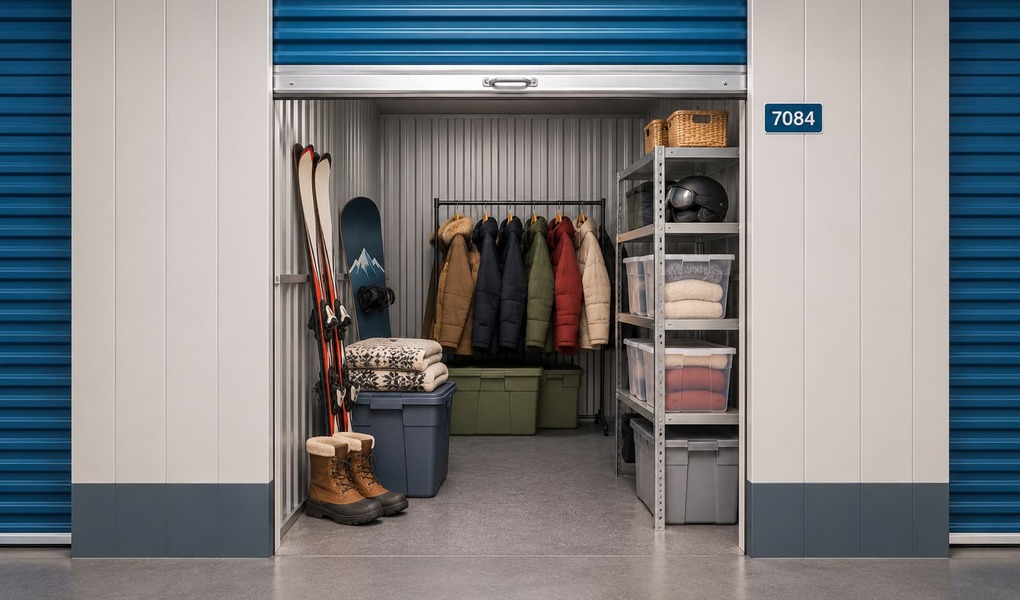
If you are swapping closets for the season, how to store winter clothes comes down to one goal: coats and sweaters that come out undamaged next year. Storing winter clothes means cleaning, drying, and packing seasonal garments in containers and a location that keeps out moths and moisture and avoids crushing. The method is short: wash first, pick the right container, and check the bins on a schedule.
The same steps cover how to store seasonal items in general, ski and snow gear included.
How Do You Prepare Winter Clothes for Storage?
How to store winter clothes starts with preparation: every item goes into storage clean and fully dry, because stains, body oils, and leftover moisture are what moths and mildew go after.
- Wash or dry clean each item.
- Dry it completely.
- Mend loose buttons and small tears, and look each piece over for moth holes.
- Fold knits and bulky pieces, or hang structured coats, in the container chosen in the next section.
- Label the container with its contents and the pack date.
When overflow bins go to a unit, the same routine applies as you pack a storage unit.
Wash or Dry Clean Everything First
Clothes moths and carpet beetles feed on wool, mohair, fur, silk, feathers, and other keratin-based fibers, Mississippi State University Extension notes, and the caterpillars, not the adult moths, do the damage. Clothing soiled by sweat, oil, and flakes of skin is more attractive to them, so the extension advises having wool and silk cleaned before storage. University of Maryland Extension adds that dry cleaning kills every stage of clothes moths but gives no protection against reinfestation. The container still matters.
Dry Items Completely Before Packing
Anything damp that goes into a bin stays damp. Feathered Friends' down care guide says to dry gear fully and never put it away wet or in a damp place. Check by hand: press the thick spots such as seams, cuffs, hoods, and collars, and keep drying until nothing feels cool or clammy.
Should You Use Vacuum Bags or Breathable Storage?
Breathable storage is the safer choice for down, wool, and structured coats. Feathered Friends says down lasts longest when it spends most of its time uncompressed, because long compression reduces loft over time. Woolmark advises against vacuum plastic bags for Merino sweaters, since the tight bag pushes the garment out of shape and leaves creases that may be hard to remove. Woolmark also notes that vacuum bags do not let clothing breathe and can trap moisture. For other bulky items, check the care label before using a vacuum bag.
| Garment type | Best container | Why | Watch-out |
|---|---|---|---|
| Down jackets and comforters | Large cotton sack, or a hanger in a closet that is opened regularly | Feathered Friends recommends storing down uncompressed so it keeps its loft | Do not leave down in a compression sack longer than needed |
| Wool knits | Breathable cotton or wool bag, or a tight-lidded plastic bin | Woolmark calls cotton or wool bags much safer for delicate clothing, and says plastic containers work if knits are dry, out of sunlight, and not unduly compressed | Vacuum bags can deform wool and leave creases |
| Structured coats | Hanger inside a breathable garment bag | The Canadian Conservation Institute advises against plastic dry-cleaner bags because they have no air circulation | Clean the coat first, since dry cleaning alone does not stop reinfestation |
| Other bulky items | Check the care label first | Woolmark and Feathered Friends give guidance for wool and down only, so the label is the guide for other fabrics | Pack only fully dry items; Woolmark says silica crystals can help with trapped moisture, and bags may need resealing |
How Do You Keep Moths and Moisture Away From Stored Clothes?
Keeping moths and moisture away from stored clothes means putting clean garments in a container moths cannot enter and keeping them somewhere dry and steady. Cedar is not a dependable moth fix. Colorado State University Extension says cedar chests repel some moths but will not consistently kill existing insects, and Mississippi State University Extension says only very fresh cedar, or cedar refreshed with cedar oil, in a tightly sealed container can kill small larvae. The Canadian Conservation Institute advises avoiding cedar chests for textiles. Mississippi State University Extension also says mothballs do not repel moths.
Bug-Tight Containers and Periodic Checks
Mississippi State University Extension advises bug-tight containers because moths and carpet beetles cannot lay eggs in clothing they cannot reach. The extension suggests plastic boxes with tight lids for sweaters. Pests already inside a bin keep thriving, so at each check look for:
- Small, light-colored moths
- Small, oval-shaped beetles
- Small, hairy larvae
- Shed larval skins at the bottom of the container
If you find any, re-clean the items. The extension also describes freezing sealed items for four to seven days.
Humidity and Temperature Benchmarks
The National Park Service publishes numbers for textiles.
| Condition | National Park Service textile benchmark |
|---|---|
| Temperature | 64 to 68 F (18 to 20 C), with an upper limit of 75 F |
| Relative humidity | Below 65%, with 50% to 55% recommended |
| Mold risk | Optimum growth conditions are generally above 75 F and above 65% relative humidity, and rapid spread occurs above 80% |
| Consistency | Fluctuations may let dormant spores start growing |
These figures come from museum guidance for historic textiles, so treat them as a benchmark, not a home requirement.
Where Should You Store Winter Clothes: Home or Storage Unit?
You can store clothes in a storage unit when closets and under-bed bins have run out of room, and keep them at home when a cool, dry interior closet has room for the bins. At home, Feathered Friends suggests a closet that is opened regularly for airflow. Garages and attics often see big temperature changes. Either way, how to store winter clothes stays the same: clean, dry, and sealed against pests.
For overflow, small storage units are the usual fit. A 5x5 holds seasonal items and closet overflow, and a 5x10 fits a small room's worth of belongings. Before you rent one, check what not to store in a storage unit.
Facilities in the network that offer climate-controlled storage have units built to help keep temperature and humidity steadier than standard units do. Features vary by facility, so ask the facility what it maintains. Storage unit organization starts with labeled bins stacked so each label faces the aisle. Put the bins you reach for most near the door.
How Do You Set Up a Seasonal Rotation System?
How to store seasonal items without losing track of them comes down to a rotation system built on a sorted closet, labeled bins, and a written inventory.
| Step | What to do | Detail |
|---|---|---|
| 1. Sort | Split the closet into "wear again in spring," "donate," and "store" | Only the "store" pile gets packed |
| 2. Pack by material | Use the decision table above | Down in cotton sacks, knits in breathable bags or bins, other bulky items as the care label allows |
| 3. Label | Write contents, owner, and pack date on each bin | Dates show which bins have waited longest |
| 4. Record | Photograph each open bin or keep a list | You find the right bin without unpacking the rest |
| 5. Schedule | Pick two swap dates a year, one for each season change | Check for moths and mildew at each swap |
| 6. Expand | If the closet is still too full, search for a small climate-controlled unit | Pick the smallest size that fits the "store" pile |
When the overflow goes to a unit, organize a storage unit the same way, because storage unit organization depends on labels and a list more than on the unit itself.
How Do You Store Ski and Snow Gear?
To store ski and snow gear, clean and wax skis and snowboards, shape the boot liners, and keep everything in a cool, dry indoor spot. The ski and boot steps below follow Dope Snow Magazine's guidance.
- Clean and dry the skis or snowboard.
- Run a gummy stone gently along the edges to remove rust and burrs.
- Apply a heavier coat of wax than usual. Dope Snow Magazine suggests roughly two to four times your usual amount on the base.
- Insert the liners in ski boots and lightly buckle or lace them, without over-tightening, so they hold their shape.
- Follow the binding maker's guidance for storage, and have a ski shop reset binding settings.
- Take the batteries out of an avalanche transceiver at the end of the season, as Backcountry Access advises.
Check your beacon maker's manual first, since models with built-in lithium-ion packs, such as the PIEPS Jetforce, are stored differently. Keep the gear off damp floors and out of garages and attics, where temperatures swing.
Frequently Asked Questions About Storing Winter Clothes
Does Cedar Repel Clothes Moths?
No, cedar is not a dependable moth repellent. Colorado State University Extension says cedar chests repel some moths but will not consistently kill existing insects, and Mississippi State University Extension says only very fresh or oil-refreshed cedar in a sealed container kills small larvae. Clean clothes in bug-tight containers work.
Is Climate-Controlled Storage Necessary for Clothing?
Climate-controlled storage suits clothing because textiles do best in stable temperature and humidity, and it is designed to hold both more consistently than standard units. The Canadian Conservation Institute warns that excess humidity leads to mold and mildew. Features vary by facility, so ask what it maintains.
Should Winter Clothes Be Vacuum-Sealed for Storage?
No, winter clothes such as down, wool, and structured coats should not be vacuum-sealed, because long compression reduces down loft and vacuum bags can deform wool and trap moisture. Check the care label before vacuum-sealing other bulky items.
Can You Store Winter Clothes in a Storage Unit?
Yes, you can store clothes in a storage unit, coats and sweaters included, when they are clean, fully dry, and packed in sealed bins or breathable garment bags. Check facility rules first. A 5x5 in the small storage unit range fits seasonal items and closet overflow.
Find Storage Near You
If the closets are full after the seasonal swap, the next step is finding a place for the bins. Ready to find storage near you? Search by city or ZIP code on USSelfStorage.com to compare pricing, amenities, and reviews across 20,000+ facilities, then reserve online for free.