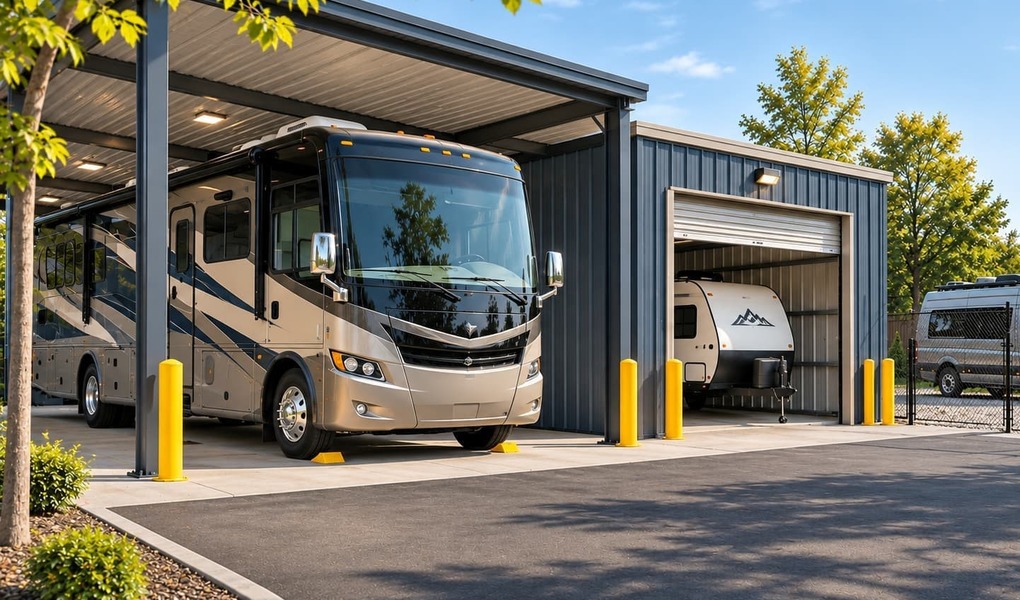
When the first freeze forecast shows up and your RV or boat is still sitting in the driveway, these RV storage tips cover what to do to the vehicle before it sits and where to park it for the winter. The checklist below ties each step to the damage it prevents, so you know why you are doing it.
Boat storage tips follow the same logic: get the water out, stabilize the fuel, and keep moisture from building up under the cover. If you ride a motorcycle or plan spring prep, those sections are further down.
How Do You Winterize an RV for Storage?
Winterizing an RV for storage means draining the water system, adding propylene glycol RV antifreeze to the lines, bypassing the water heater, and preparing the battery and tires so nothing freezes or degrades. These RV storage tips start with plumbing because water expands when it freezes, and the same plumbing steps apply whether the RV waits in a driveway or in RV storage at a facility.
Plumbing and Water Heater
- Drain the fresh tank, run the pump with every faucet open, and open the low-point drains.
- Empty the black tank first and the gray tank second.
- Let the water heater cool, drain it, and set the bypass valves to bypass. Water left in the heater can freeze and expand, which can crack the tank or damage fittings.
- Run propylene glycol RV antifreeze through each faucet until pink fluid appears at every faucet and drain.
Check the label, because some propylene glycol products blend in ethanol. Automotive antifreeze is poisonous and does not belong in a drinking-water system. Keystone owner instructions also describe a compressed-air method: blow the water out of the lines, then pour about one quart of RV antifreeze into each drain, P-trap, and toilet, leaving a little in the toilet to maintain the air seal. Pressure limits belong to your manual. Tankless heaters have their own procedure, and the owner's manual wins whenever steps conflict.
Tires, Battery, and Propane
For the tires, Michelin's RV tire guide advises a barrier such as plywood or rubber mats under each tire, a cover over outdoor tires to block sunlight, and a pressure check before and after storage.
Disconnect the battery or keep it on a tender, and keep the terminals clean, as your owner's manual directs. Close the propane tank valve and follow the manual for storing the tank. Close gaps where pests could get in, and skip mothballs, which are pesticides that can harm people and pets.
How Do You Winterize a Boat for Storage?
Winterizing a boat for storage means stabilizing the fuel, fogging the engine, draining water from the engine, plumbing, and hull, and covering the boat with something that breathes. Start before the first hard freeze, since water trapped in an engine can crack it.
Engine and Fuel
- Add fuel stabilizer, which BoatUS says keeps gasoline from oxidizing over the winter. Then run the engine long enough for treated fuel to reach the whole fuel system. Yamaha outboard guidance says at least 15 minutes. Fill the tank as your manual directs.
- Fog the engine. Yamaha explains that fogging oil coats internal surfaces such as pistons, cylinder walls, and valves. BoatUS describes injecting it through the carburetor or air intakes while the engine runs, or spraying it into the cylinders with the spark plugs removed.
- Drain the water. Yamaha says its outboards self-drain when upright. For inboard and stern-drive engines, follow the engine maker's manual; BoatUS describes draining the cooling system or circulating propylene glycol antifreeze through it.
- Drain the gearcase lubricant and check its color. Milky fluid can mean water got in.
- Keep the battery on a marine charger with a float setting, or charge it fully at least once a month.
Hull, Plumbing, and Cover
Drain the heads, sinks, and tanks, then run non-toxic antifreeze made for potable water systems through the plumbing. BoatUS says drain plugs must be out for the winter to prevent freeze damage, so pull the hull drain plug and keep the bilge clear of debris.
Choose a vented cover or vented shrink wrap, because BoatUS notes that shrink wrap without vents traps moisture and causes mildew. Support the cover on a frame so water does not pool on it.
Covered vs. Indoor vs. Outdoor Storage for RVs and Boats
Covered, indoor, and outdoor storage for RVs and boats differ mainly in how much sun, snow, and moisture reach the vehicle. Three hazards drive the choice. UV rays fade paint and decals and dry out roof sealant and tires. Melting snow can pool water on a roof and stress the structure. Moisture trapped under a cover condenses and can lead to mildew.
| Storage type | What it reduces | What it does not stop | Notes |
|---|---|---|---|
| Outdoor | Nothing on its own; your cover does the work | UV, snow load, and condensation without a good cover | Use a breathable cover. Plastic tarps trap condensation. Check each listing for security features |
| Covered | Snow and sun on the roof | Water already in the plumbing, engine, or bilge; the sides stay exposed | Still winterize. Check the listing for details |
| Indoor | Exposure to sun, rain, and snow | Water already in the lines | Security features and climate control vary by facility |
A roof or a building does not replace the draining and antifreeze steps above. It lowers weather exposure but does not take water out of a plumbing system or engine block.
If you prefer to keep the vehicle on a lot, outdoor vehicle storage works with a fitted cover. Vehicle storage listings show which types each facility offers, and covered vehicle storage varies by location.
How Do You Store a Motorcycle for Winter?
Storing a motorcycle for winter comes down to treated fuel, a charged battery, supported tires, and a breathable cover in a ventilated spot. Motorcycle storage is simpler than RV or boat prep because there is no plumbing to drain, but moisture is still a risk.
- Fill the tank, add fuel stabilizer, and run the engine for a few minutes so the treated fuel circulates.
- Change the oil and filter before storage.
- Connect a battery tender (trickle charger) to keep the battery charged.
- Check tire pressure and follow the owner's manual for supporting the bike while it sits.
- Use a breathable cover, never plastic, which traps moisture.
- Store it indoors in a ventilated spot if you can.
Motorcycle storage on USSelfStorage.com is an option when your garage is full.
What Should You Check Before Reserving RV or Boat Storage?
Before reserving RV or boat storage, check the storage type, access, amenities, reviews, and listed requirements on each facility page. USSelfStorage.com is a marketplace where you search, compare, and reserve, and it does not own or operate any facility. Searching for RV storage near me or motorcycle storage near me works the same way here: enter a city or ZIP code and review what facilities listed on the platform show.
Compare drive-up access and covered or indoor options. Read each listing for requirements such as insurance or registration, along with access hours and security features. Look at RV storage and boat storage pages for vehicle-specific options, and check for covered vehicle storage if shelter from weather matters most.
On USSelfStorage.com, the unit size guide lists 10x30 as the unit size for vehicles. Measure your RV, boat, or motorcycle and ask the facility what fits, since vehicle spaces vary. Confirm real-time availability and current pricing on the listing before you reserve.
Spring De-Winterizing Checklist for RVs and Boats
De-winterizing an RV or boat in spring means reversing the winter steps once freezing weather has passed, and your owner's manual sets the exact order for each model. Wait until the forecast shows no more freezing temperatures before you start.
| System | What to do | Why |
|---|---|---|
| RV water system | Close the low-point drains, return the bypass valves to normal, and run fresh water at every fixture until it runs clear with no pink tint. Check for leaks with the system pressurized. Follow the manual's flush and sanitizing procedure before use | Antifreeze should not stay in drinking-water lines, and leaks show up once the system is under pressure |
| RV tires and propane | Check tire pressure and condition, including cracking. Reconnect propane and check for leaks as your manual directs | Michelin notes that a pressure drop during storage can point to a slow leak |
| RV battery | Check the battery's charge and condition, reconnect it, and keep the terminals clean | A battery that sat all winter should be checked before the first trip |
| Boat fuel and fluids | Inspect fuel lines and hoses, check filters, and check fluid levels as your engine manual directs | Fuel lines, filters, and fluids sat unused all winter, so check them before launch |
| Boat engine and gearcase | Confirm the engine procedure in the manual, and check the gearcase lubricant for a milky color | A milky color can signal water in the gearcase |
| Boat hull | Replace the hull drain plug before launch, then check thru-hulls for leaks after launch | The plug is pulled for winter, so confirm it is back in |
Frequently Asked Questions About Boat and RV Winterizing and Storage
What Happens if You Don't Winterize Your RV Before Storage?
If you don't winterize your RV before storage, water left in the lines and water heater can freeze, expand, and crack the tank or damage fittings. The RV checklist above lists the steps in order.
Is Covered Storage Enough to Protect a Boat Over Winter?
No, covered storage reduces weather exposure but does not replace draining the engine. A roof does not remove water from the engine, plumbing, or bilge, and BoatUS says water left in an engine can crack the block. Search storage near you by city or ZIP code to compare covered options.
Do You Need a Battery Tender for Motorcycle Winter Storage?
Yes, a battery tender (trickle charger) is the common way to keep a motorcycle battery charged during winter storage. The owner's manual governs the exact procedure.
Do You Need to Winterize an RV That Is in Indoor Storage?
Yes, winterize an RV in indoor storage unless you are certain the space stays above freezing all winter, because indoor storage reduces weather exposure but does not remove water already in the lines.
Find RV and Boat Storage Near You
A winterized RV or boat still needs a place to sit until spring, so the last step is choosing where to park it. Ready to find boat storage or RV storage near you? Search by city or ZIP code on USSelfStorage.com to compare pricing, amenities, and reviews across 20,000+ facilities, then reserve online for free.